See how AI sees your company
Pulse — AI Visibility Monitor
A living view of how AI systems discover, interpret, and talk about your company
See what AI says about your company and whether it gets it right. Pulse keeps watch and alerts you when things change, so you know what improved and what still needs your attention.
A different kind of visibility audit
Being mentioned is not the same as being understood.
AI visibility begins with a simple question: when someone asks an answer system about your category, does your company appear?
The useful work starts after the mention: how the company is described, what evidence shapes the answer, and whether machines have a stable identity to work from.
A report you can interrogate
The signal first. The evidence underneath.
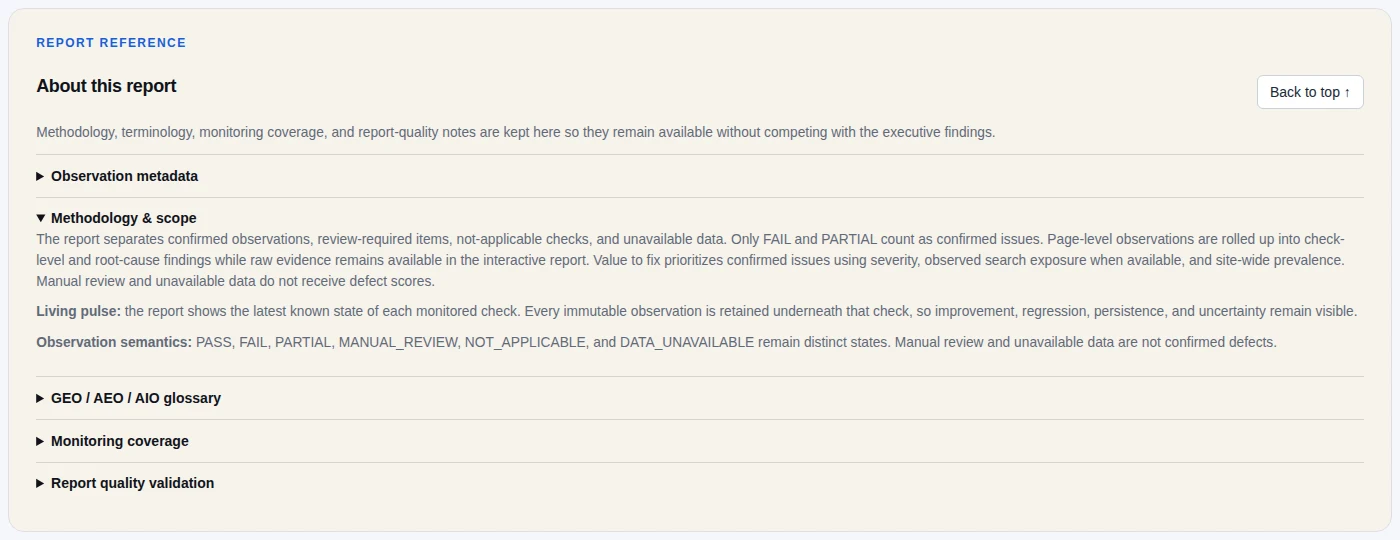
These are captures from the actual interactive report. In the live version, findings, supporting checks, page evidence, interpretation, and monitoring history remain expandable instead of being flattened into a score.
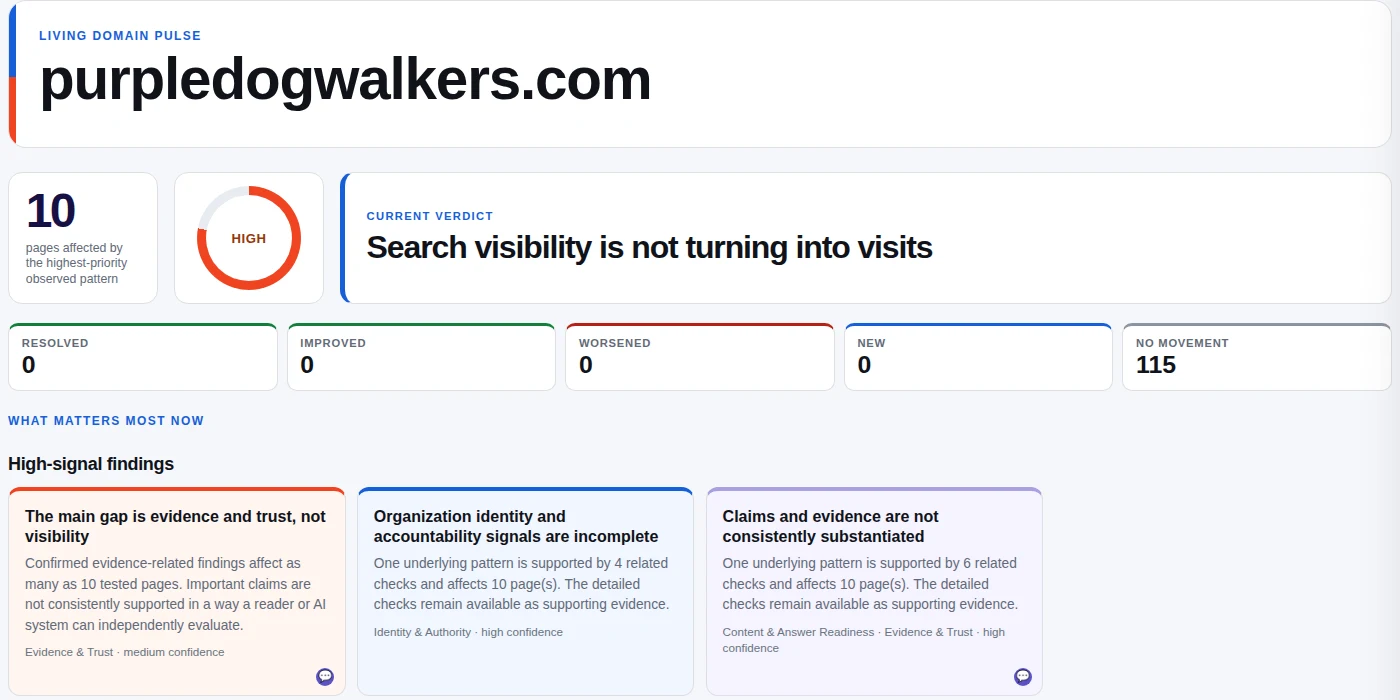
AI response analysis
Ask the machines. Then inspect the answer.
The audit tests repeatable questions across answer systems, records which companies surface, and compares how providers characterize the same entity.
It separates discovery, representation, source dependence, provider differences, and confidence instead of reducing AI visibility to a mention count.
The observation stays visible
Raw evidence, model analysis, and human judgment are different layers.
The report records what was actually collected before interpreting it. Missing or malformed provider responses stay unavailable evidence; they are not quietly converted into “the company was absent.”

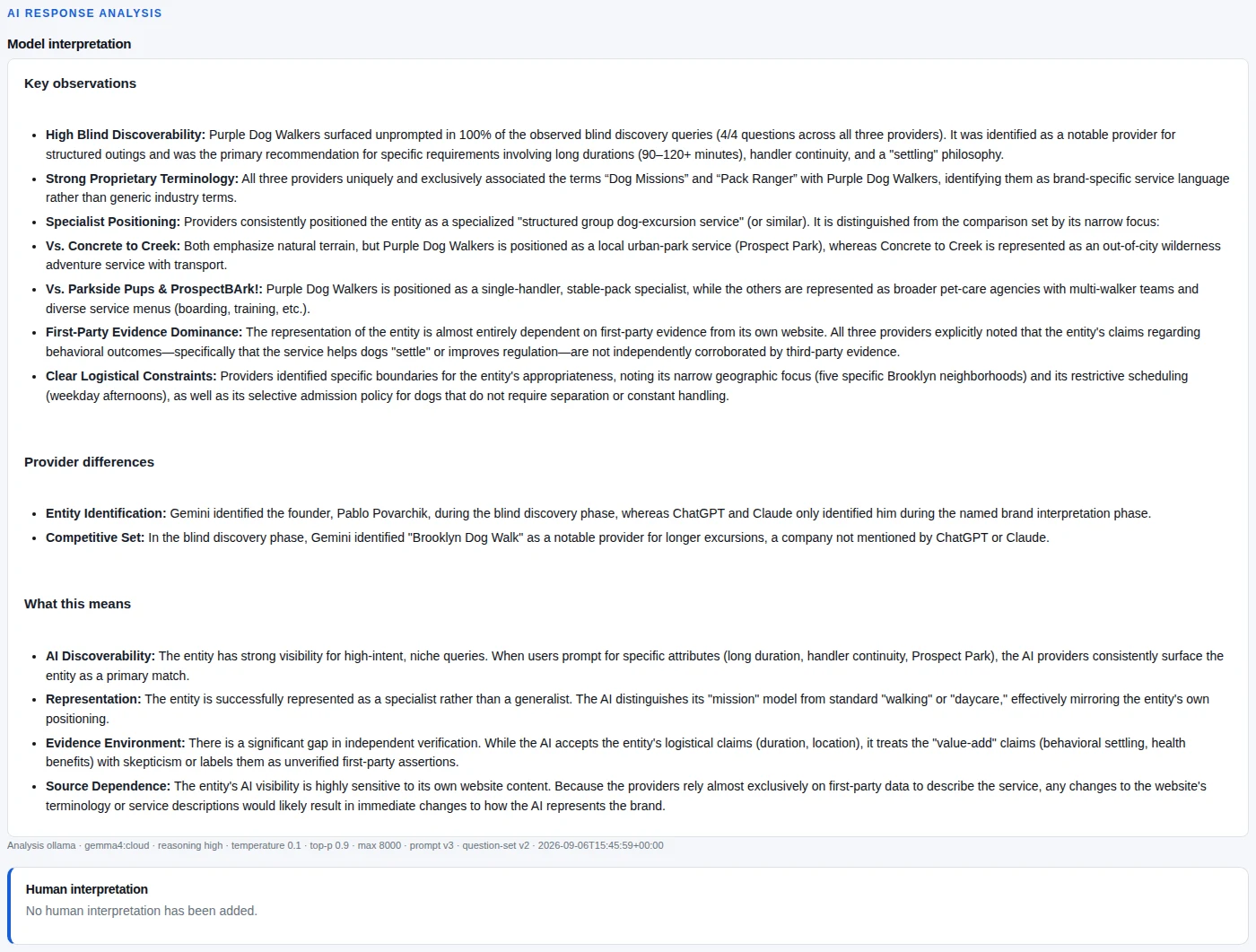
Identity & authority
Can an AI establish who you are—and why it should believe you?
Clear identity gives machines a stable subject. Authority and evidence give them reasons to preserve the right claims.
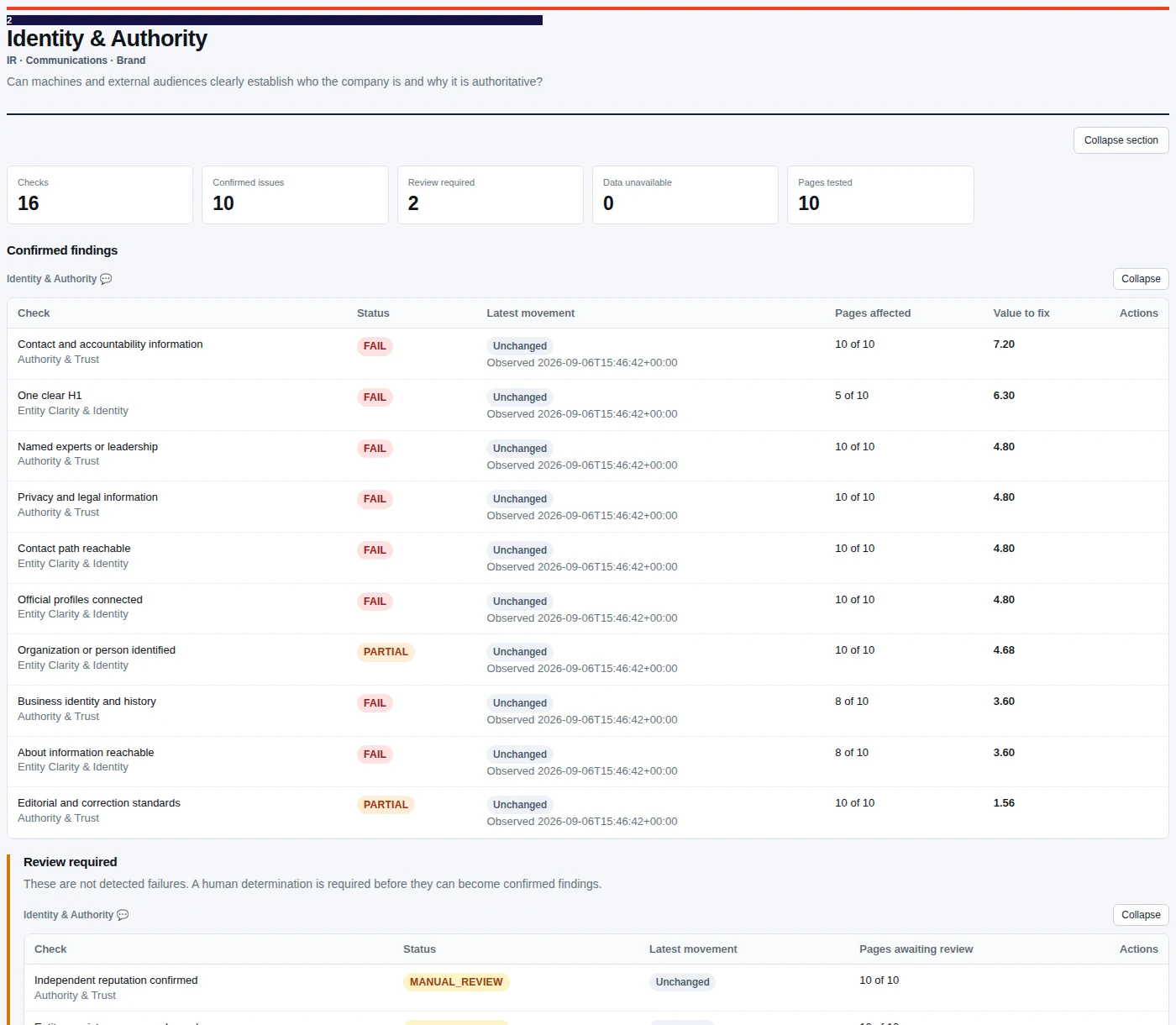
Do less. Fix the right things.
The report does not ask you to fix everything.
Page-level failures are rolled up into root patterns so repeated problems do not become repeated executive recommendations.
Value to fix prioritizes confirmed issues using severity, observed search exposure when available, and site-wide prevalence. The point is to surface the small amount of work most likely to matter first.
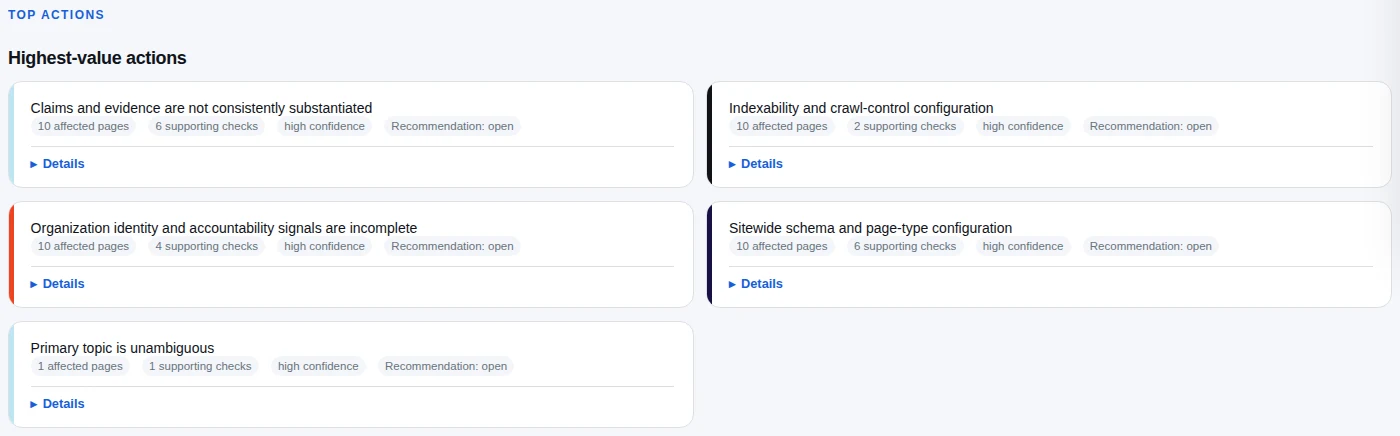
Seven connected views
The report follows the whole representation system.
The AI Visibility product uses seven connected views. The first measures AI representation directly; the others explain the identity, evidence, content, technical, search, and site conditions that can shape it.
01AI VisibilityWho appears, how often, and from which sources?
Measures blind discovery, named-brand interpretation, provider differences, citation patterns, and source dependence.
- Mention and prominence
- Category consistency
- Provider source patterns
02Identity & AuthorityCan machines establish who the company is?
Inspects entity clarity, leadership, accountability, profiles, reputation, authorship, and consistency across channels.
- Clear responsible entity
- Reachable contact path
- Independent authority signals
03Evidence & TrustCan important claims be independently evaluated?
Looks for source attribution, external support, methodology, quantified-claim support, and visible review standards.
- Supporting sources
- Claim attribution
- Verification context
04Content & Answer ReadinessCan answers be extracted without losing meaning?
Tests intent coverage, content depth, question-led structure, explicit definitions, comparisons, and answer completeness.
- Question and intent alignment
- Answer extractability
- Content depth and originality
05Machine Readability & EligibilityIs the information technically usable?
Connects structured data, semantic structure, page identity, indexability, and answer-system eligibility.
- Page-type schema
- Canonical identity
- Semantic landmarks
06SEO AuditWhere is organic search demand and exposure?
Keeps search performance available as a supporting view rather than confusing rankings with AI representation.
- Demand and query exposure
- Landing-page performance
- Search opportunities
07Onsite AuditIs the site healthy enough to be observed?
Checks crawlability, accessibility, page health, and technical conditions that determine whether evidence can be reached.
- Crawl and index controls
- Accessibility
- Technical health
A living domain pulse
An audit gives you a state. Monitoring gives you movement.
The report is the latest known state of each monitored check. New observations do not replace the old ones: they accumulate underneath the check so improvement, regression, persistence, review-required items, and unavailable evidence remain distinguishable.

Independent by design
The person finding the problems does not get the repair contract.
I perform the audit and interpret the findings. The report can identify the kind of work required and the professional best suited to do it. I simply do not take that downstream contract, to protect the report’s integrity and independence.
That separation removes the incentive to inflate findings, turn every issue into a project, or recommend a larger intervention when a smaller one would do.
What happens when you bring me a domain
Start with a baseline. Keep the same report if you want it monitored.
- 01Observe
Run the site, search, and AI-response evidence needed to establish the current state.
- 02Interpret
Separate detected facts, model analysis, unresolved questions, and my interpretation of what matters.
- 03Prioritize
Roll repeated failures into root patterns and identify the work worth addressing first.
- 04Monitor
Later observations update the same living report so movement is visible instead of buried in disconnected snapshots.
Start with a domain
See the representation system behind the answer.
Explore the live sample first, or bring me a company whose AI visibility you need to understand.